Open shelving is honest in a way closed cabinets are not. Everything you put there is part of the room, and the fastest way to make a tidy shelf look chaotic is to line up containers that don't agree with each other. The question readers ask most is deceptively simple: bins or baskets? The answer isn't one or the other. It depends on what's sitting inside, how often your hands are in it, and how much housekeeping you want to sign up for.
Before you shop, empty the shelf and group what actually lives there. Soft goods behave differently from small hard items, and daily-use things behave differently from seasonal ones. A shelf holding folded towels, extra blankets and guest linens has different needs than one holding batteries, tape, chargers and craft odds and ends.
The single most useful rule: the more often you reach for something, the more open its container should be. Anything you touch several times a week — coffee filters, dog treats, school snacks — wants a basket or an open bin you can grab from without unlidding anything. Anything you touch twice a year — holiday decor, spare lightbulbs, tax documents — is a candidate for a lidded bin that keeps dust off and stays put.
Bins and baskets solve visibility in opposite ways, and neither is automatically better.
You can see exactly what you own, which is excellent for small categories that are easy to overbuy — think batteries, pens, hair ties. The trade-off is that clear plastic is unforgiving. Every tangled cord and half-empty bag of paper clips is on display. Clear bins work best when the contents are uniform, like a row of matching spice jars or neatly folded white linens.
Solid bins, whether plastic, metal or fabric, create calm. A row of identical gray bins on a closet shelf reads as one clean block instead of twelve small decisions. The cost is memory: you have to label them, or you will spend real time opening four bins looking for the stapler.
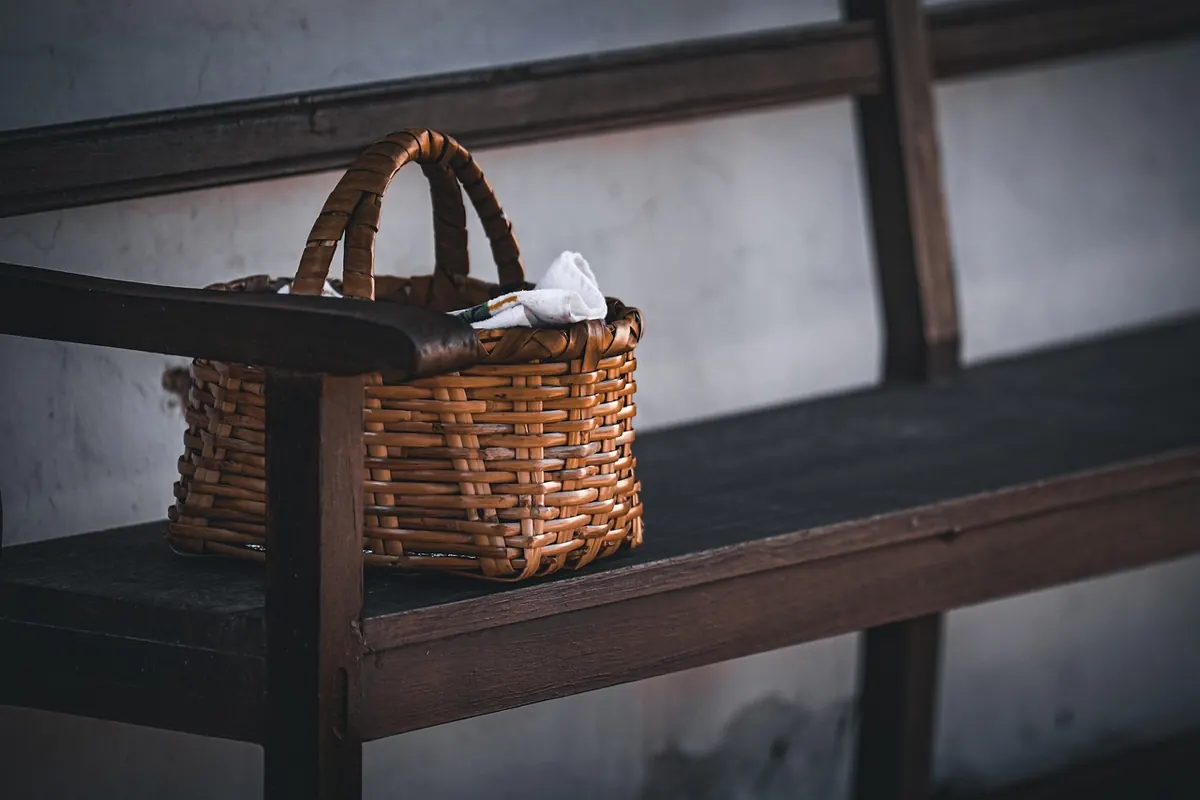
A woven basket is a compromise. You catch the general shape and color of what's inside — a hint of blue towels, the tops of wooden blocks — without the full inventory. Open-weave baskets read as softer and more forgiving than plastic, and they hide mismatched packaging better than anything else on this list.
Try the squint test. Step back, blur your eyes, and look at the shelf. If you see five competing shapes and colors, you need more opacity. If you see one calm rhythm, the shelf is working.
This is where lidded bins win outright. Open shelving collects dust no matter what sits on it, and a lid removes one entire cleaning step. If the shelf is in a garage, basement or near a kitchen, that matters more than style.
One caution worth repeating: natural fibers and constant humidity don't mix. Skip seagrass, jute and untreated wicker in bathrooms, laundry rooms and damp basements, where they can turn musty. Choose plastic, coated wire or sealed fiber instead.
Cheap thin plastic cracks at the rim and the handle, especially when you load it heavily and drag it off a shelf. Better polypropylene bins hold up for years, but they bow when stacked with weight. Fabric bins keep their shape with stiff inserts and collapse once those soften, so keep them for light, bulky things like scarves and stuffed animals.
Wire baskets are the workhorses — sturdy, washable, nearly impossible to overload — but they can scratch painted shelves, so add felt pads on the base. Woven baskets can last decades with care, though they snag on rough edges and lose shape if you cram them. Match the container to the weight: heavy items belong in rigid bins or wire, light and bulky items suit fabric or woven.
Baskets bring warmth and texture. They soften a shelf of books, look intentional in living rooms and bedrooms, and absorb the visual noise of mismatched packaging. Bins look crisper and more uniform, which suits pantries, closets, utility rooms and kids' rooms where function leads.
Consistency beats material. Two finishes on one shelf looks deliberate; five looks like a clearance aisle. Pick a palette — natural seagrass with white, or matte black bins with wood — and repeat it.
Most well-organized shelves use both, divided by job rather than by loyalty. In a pantry, put open baskets on the low shelf where kids grab snacks, and lidded clear bins up high for baking supplies you use monthly. In a bathroom, keep sealed bins under the sink and one woven basket on the open shelf for rolled towels. In a laundry room, plastic bins for detergent and lint brushes, a basket for the odd socks pile.
Measure before you buy: shelf depth and the height between shelves, then subtract about an inch and a half of clearance so you can actually lift things out. Buy one container, live with it for a week, then buy the rest. And leave a little air on each shelf — a gap at the end of a row does more for the look than any container choice you'll make.
Photo: mariya_m / Pixabay