Open shelves never hide anything. That is exactly why people love them, and exactly why they can go wrong so fast. A cabinet door forgives a jumble of mismatched containers; an open shelf puts every object on display all day long. The fix isn't owning less or being naturally tidy. It's making a few composition decisions once, then maintaining them with small habits that take minutes.
Before you restyle a single shelf, take everything off it. Sort the contents into three piles: things you use daily, things you use occasionally, and things that are purely there to be seen. Then decide honestly how much of the shelf each pile deserves. Kitchens usually reveal the problem first — a shelf that holds eight mugs, three jars of spices and a blender is doing storage work, not decorative work, and no arrangement will make that look calm.
If daily-use items are crowding out everything else, move some to a closed cabinet. Open shelving works best when roughly half of what sits on it is there for looks, and the rest is genuinely attractive enough to live in plain sight.
Work from large to small, the same way you'd arrange furniture in a room. Put the biggest objects down first: a wide basket, a stack of art books, a large ceramic bowl, a framed print leaning against the wall. Space them out along the shelf rather than clustering them in the middle.
Think in thirds. If a shelf run is long, imagine it split into three zones and give each one something with visual weight. This prevents the classic lopsided shelf where everything huddles on the left and the right end sits bare.
Books are the best-behaved objects on an open shelf. They're rectangular, they arrive in multiples, and they hold their own shape. A few ways to use them well:
A basket does the same job as a cabinet door. Anything visually busy — charging cables, mail, children's craft supplies, odds and ends — goes into a lidded box or a woven basket, and the shelf instantly settles down. Choose baskets in a single material or a single tone so they read as one family: all natural fiber, or all matte black, or all pale grey. Vary the sizes instead of the finishes.
Leave one basket slightly open with a folded blanket or a few magazines showing. Total opacity can feel like you're hiding something; a small glimpse makes the shelf look lived in.
The most common styling mistake is filling every shelf edge to edge. Negative space is what signals that the objects were chosen, not merely stored. As a rough guide, let a shelf sit about two-thirds full, with a few inches of breathing room between groupings, and keep at least one shelf in the run mostly open.
Empty space has a practical job too. A shelf with room to spare can absorb a stack of mail for an afternoon, or hold a glass while you're setting the table. A shelf packed tight has nowhere to put anything down, so things end up on the counter instead.
Once you have a pattern that works, you can rebuild any shelf in the house in a few minutes. Try this sequence:
Vary the rhythm as you move up. If one shelf follows the full formula, let the shelf above hold just a basket and one object. Repeating the same arrangement on every level looks mechanical; alternating between full and sparse shelves feels collected.
Styling is the easy part. Drift is the real enemy — the keys, the receipts, the headphones that migrate onto the shelf and never leave. A few habits keep the arrangement intact:
Perfect shelves aren't the goal, and you don't need them. Every few days, walk past the shelves and do three things: straighten any leaning book stack, return stray items to their tray or their proper room, and shift one object slightly so it isn't crowding its neighbor. That's it — about five minutes of small corrections that keep the whole wall looking intentional.
The best open shelving looks like someone lives there and cares about the room. A little imperfection is fine. What you're after is a shelf that reads clearly from across the room: a few anchors, some texture, a place for the things you use, and enough air between them that your eye can rest.
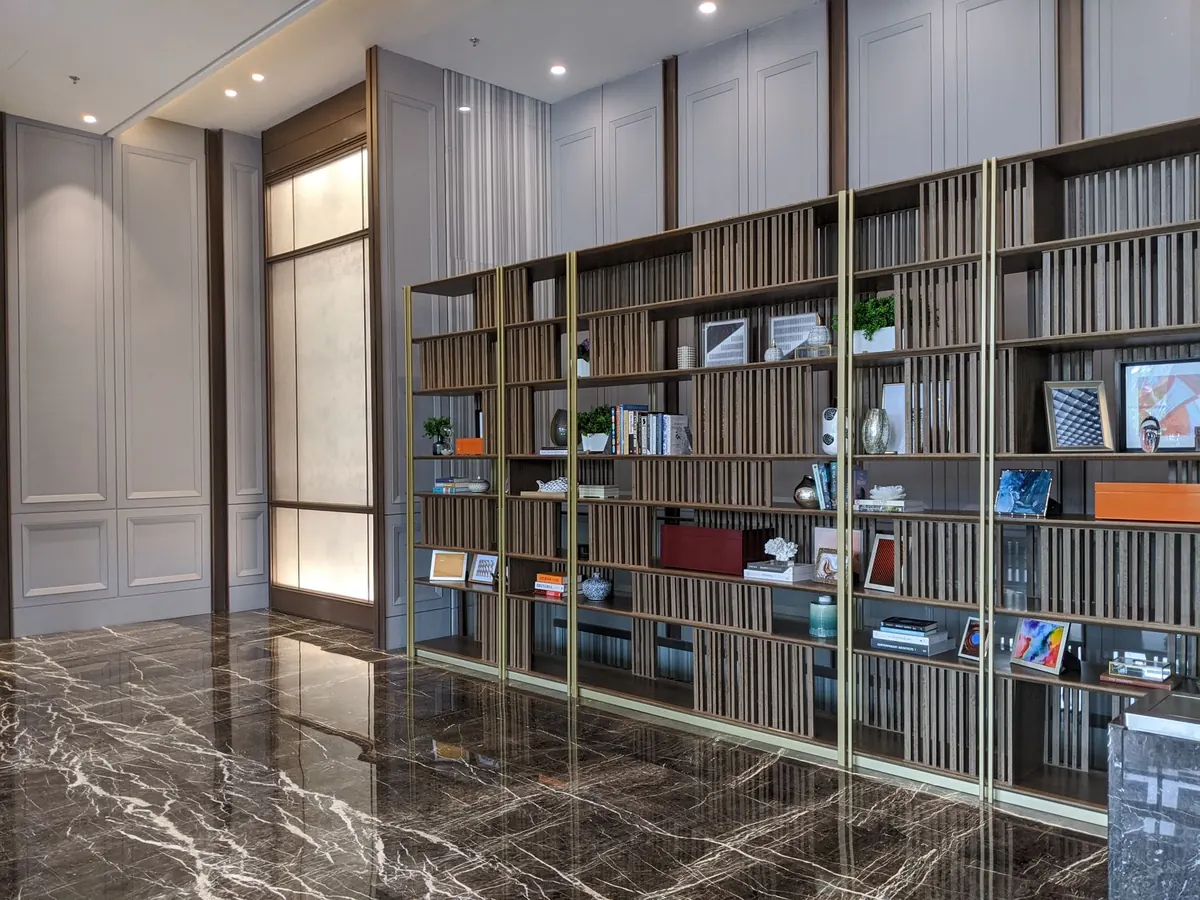
Photo: Riandy Saputra / Pexels