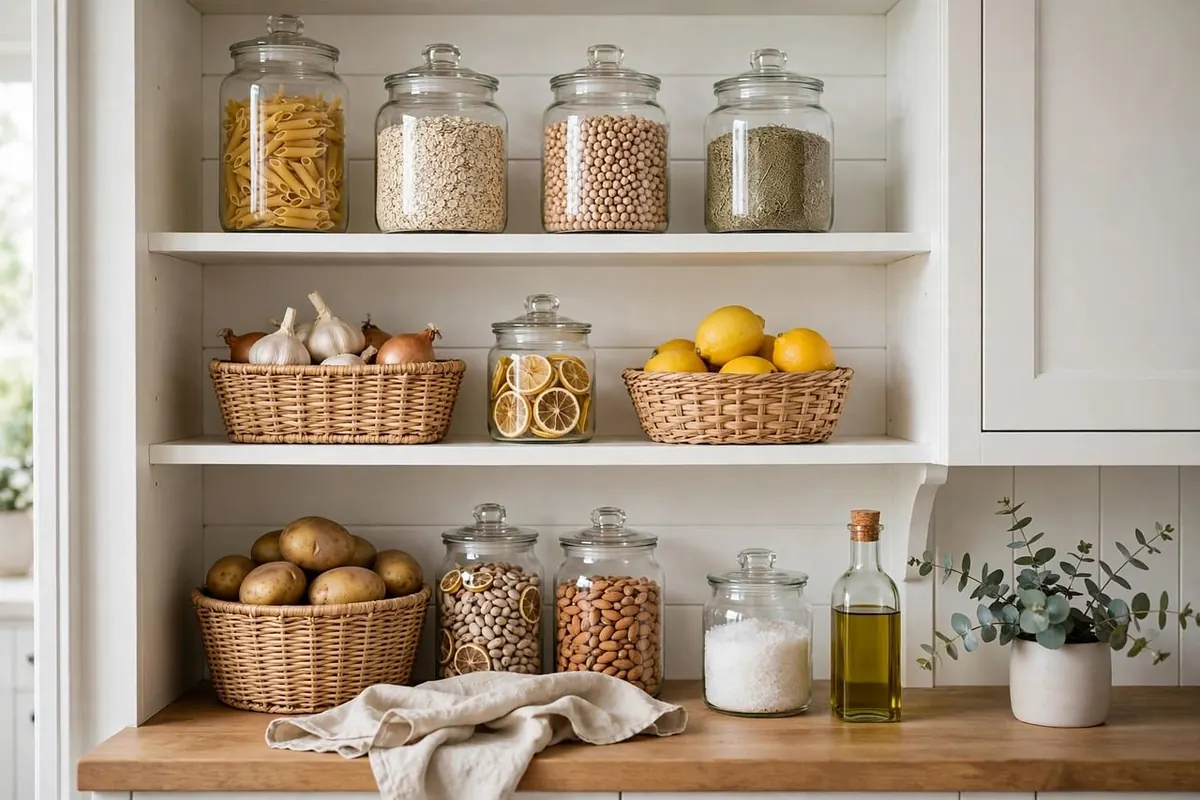
An organized pantry looks effortless in photos: matching jars, tidy rows, nothing out of place. Real pantries have to survive a Tuesday night, two people cooking at once, and a grocery run that arrives with three bags of things you already own. Most pantry projects don't fail from laziness. They fail from a handful of predictable planning mistakes — the kind that leave you with a shelf that's prettier than it is useful. Here are the ones worth avoiding.
This is the most common and most expensive error. A set of matching containers goes on sale, you buy twenty-four of them, and then you discover that the deep shelf is too shallow for the tall ones, the cereal boxes don't fit any of them, and the half-used bags of lentils are still sitting in their original packaging because you ran out of jars.
Containers should be a response to a problem, not the starting point. Empty one shelf at a time, group what comes off it, and measure the depth and height of the space before you buy anything. Square and rectangular containers waste far less shelf space than round ones. And not everything needs decanting: rice, dried beans and pasta you use slowly can stay clipped in their original bags behind a labeled bin. Transfer only what you reach for often, what comes in flimsy packaging, or what you tend to overbuy because you can't see how much is left.
Flour with flour, pasta with pasta, cans with cans. It looks logical on a shelf and it quietly works against you, because cooking doesn't happen by category — it happens in combinations. You don't make a cake by visiting four different shelves. You gather flour, sugar, baking powder, vanilla and chocolate chips in one motion.
Build stations instead. A baking bin, a breakfast shelf, a pasta-and-sauce basket, a taco-night box. When everything a meal needs lives together, weeknight cooking gets measurably faster, and you stop buying a third jar of cumin because you couldn't find the second one.
The pantry isn't a display case. It's a working shelf, and it should be arranged around what you actually cook.
Backstock. The overflow cans, the second bag of flour, the extra bottles you bought on sale. Keep those grouped by type and by date, out of the way, and treat them as a restocking drawer rather than a shelf you cook from. Your working shelves stay organized by use; your backup stays predictable.
The back of a pantry becomes archaeology surprisingly fast. Two-year-old breadcrumbs, a jar of something you can't identify, three open bags of the same spice. Organizing is the moment to deal with dates, because you'll never have a better view of everything at once.
Date labels help more than memory does. Write the month and year on a container or bag when you open it. For anything questionable — bulging cans, damaged seams, a strange smell — throw it out rather than gamble on it, and check a trusted food safety source if you're unsure.
Bulk buying only saves money if the food gets eaten. Before you bring home the ten-pound bag of oats, decide where it will live and how you'll portion it: a small jar up front for daily use, the rest sealed in backstock. If you can't answer where it goes, buy the smaller size. Paying a little more per ounce beats discovering a weevil colony in six months.
Pantries get organized by what fits rather than by what your body does. Put the things you touch daily between hip and eye level: oils, salt, coffee, the cereal you eat every morning. Heavy items — bulk flour, large jars, drinks — belong low, where lifting them is safer and where a fall won't cost you a shelf of glass. The top shelf is for holiday platters and the fondue set you use twice a year, plus a folding step stool within reach.
Vertical space is the one most people leave on the table. Measure the gap between shelves and use stackable bins or a small riser to create a second layer where there's room for one.
A pantry packed to capacity has no room to be used. You can't slide a new jar in, you can't pull the front item out without unloading the shelf, and you stop seeing what's there. Aim to leave a small margin of empty space — roughly a tenth of each shelf — and treat it as working room, not wasted room. The rule that keeps it that way: nothing new comes in until something comes out.
Once the structure is right, maintenance takes minutes. Before you write a shopping list, walk to the pantry and look — snap a photo of the shelves if you shop from your phone, so you're buying from what you have rather than from memory. Keep a running list of what's running low. Do a two-minute reset before each grocery run: return strays, pull forward the oldest items, and drop anything expired. Once a month, check the backstock and move whatever is closest to its date into the working shelf.
If the whole pantry feels overwhelming, start with one shelf — the one you open most. Fix that, live with it for a week, and let the improvement convince you to do the next one. A pantry that's slightly imperfect and genuinely easy to use beats a photograph-perfect shelf you're afraid to cook from.